
Best In-Person RYT-200 Yoga Teacher Trainings for 2026: My curated list
When I became a yoga teacher, I couldn’t believe how hard it was to find a consolidated list of excellent yoga teacher trainings and continuing education workshops hosted by vetted and experienced senior teachers.
This is something I get asked about at the end of class frequently, so I thought I would offer a resource to help people find what they are looking for!
While I love the accessibility that online training offers, I’ve found time and time again that the investment into an in-person training, especially for an RYT-200 Hour training program, makes a huge difference in the quality of the training, depth of connection with the other students in the program, and the feelings of confidence for a new teacher just starting out leading students.
Don’t get me wrong, as a Mom of little kids I have done my fair share of both in-person and online training, however, I would always recommend in-person training if resources and availability allows!
Who am I and how did I come up with this Yoga Teacher Training list?

To give you a little bit of background on me, I have been working in the Health and Wellness space for over a decade after an early career in Investment Banking. I’ve been practicing yoga since I was in college, and have been teaching yoga professionally since 2020 in the San Francisco Bay Area and Tri-State area outside of New York City. I have an RYT-500 and E-RYT 200 certification from Yoga Alliance.
I currently teach weekly classes in San Francisco and Marin county, and over the course of my teaching have taught at ten studios around the Bay Area and tri-state area. I’ve seen alot!
I’ve completed lots of additional trainings in different continuing education fields and I absolutely love diving into different trainings, yoga history lessons and anatomy deep-dives! I find that investing in training and continuing education keeps my practice and my teaching fresh because I have new themes to roll with and techniques to implement that keep me on my toes!
My personal preference in terms of yoga asana “style” is heated power vinyasa yoga based on the Journey into Power flow by Baron Baptiste. I think this is a fantastic “foundational” style for any new yoga teacher to evolve their practice from. My “reasoning” for this is that when a new teacher learns from a set sequence without music, with practice, they are able to consistently deliver an excellent breath-based class. This is in contrast to a newer vinyasa teacher who (might or might not be) pouring so much attention into creating an “exciting” sequence and playlist, that they miss out on connecting with the students.
On the contrary, when the foundation is learning how to pace a class using breath, it makes for a powerful teacher who can read the room based on the breathing. Years later, I find that when those teachers evolve into different styles, the teaching originates from a very empowered place. That being said, I have completed lots of trainings in many varying styles including regular vinyasa, hatha, pre-natal, post-natal, yin, restorative, etc. You’ll find in my full list of recommended upcoming trainings below, I’ve included both Baptiste trained teachers and other excellent Vinyasa style teachers too.
All of the trainings on this list are hosted by teachers who I have personally met, taken a class from, or heard enough about from other experienced and senior teachers that I feel comfortable recommending.
What questions should somebody ask themselves when deciding on a 200-Hour Yoga Teacher Training?
Yoga teacher training is a big investment and you should absolutely ask a series of questions before taking the plunge. My experience is that trainings can be VERY different based on the facilitators and where their education comes from.
Here are the top 9 questions I recommend you ask yourself before signing up. I’ll go through each question in depth below.
Do the facilitators teach in a lineage or style of yoga that I am excited about?
Will the training go into yoga philosophy and themes beyond the physical asana practice?
In what ways could this training benefit me as an individual, beyond my time on my yoga mat?
Do the facilitators have experience teaching to the types of groups I am most interested in serving?
Does the price of this training match what is do-able for me right now?
Is there a clearly defined ‘path to teach’ following the completion of the training?
Is the Training Program or Facilitator accredited by an organization that matters to me?
Do the facilitators teach in a lineage or style of yoga that I am excited about?
There are sooo many different variations of the physical asana practice of yoga. Some versions include: Hatha yoga, Ashtanga yoga, Mysore style, Iyengar yoga, Vinyasa yoga (a subset of Hatha yoga), Restorative yoga, Yin yoga. Some more ‘modern’ versions also include, Baptiste Power Yoga, Kundalini Yoga, Bikram Yoga, Katonah Yoga, etc. Additionally, some of these styles of yoga are intended to be practiced in a heated environment, and some are not.
You’ll want to be sure that the facilitators leading your training teach a style of yoga that is what you are most interested in teaching. Before you sign-up for a teacher training, take the facilitator’s classes so you can get an idea of what their teaching style is like and make sure it is a vibe fit for you. If you can’t go to their in-person classes, most facilitators would likely be happy to email a digital version or recording of their class if it will help you decide on whether or not to enroll in their teacher training.

Will the training go into yoga philosophy and themes beyond the physical asana practice?
Check the curriculum or ask the facilitator what time will be spent on yoga philosophy. I wouldn’t recommend a 200-Hour course unless the facilitators spent some time on the history of yoga, the 8 Limbs of Yoga, meditation, the Yamas and the Niyamas, and at least a mention of Ayurvedic Medicine.
There is obviously a lot to cover in a 200-hour training. These topics are essential building blocks as you journey through your life as a practitioner and teacher of yoga, and they should have some air time in training. A good facilitator will plant seeds that will make the individual students in the training curious to dive deeper individually into whatever piece of philosophy most resonates with them at that time.
In what ways could this training benefit me as an individual, beyond my time on my yoga mat?
This is a great question to ask either your facilitators or somebody who has completed this training recently. For me, one of the most amazing parts of the training was seeing the other students’ careers and relationships flourish and shift in a whole variety of ways during and after the completion of the training.
A great yoga teacher training will offer a container where the individual students feel safe to explore what it could look like for their own intentions and actions to be more closely aligned to a clear middle path.
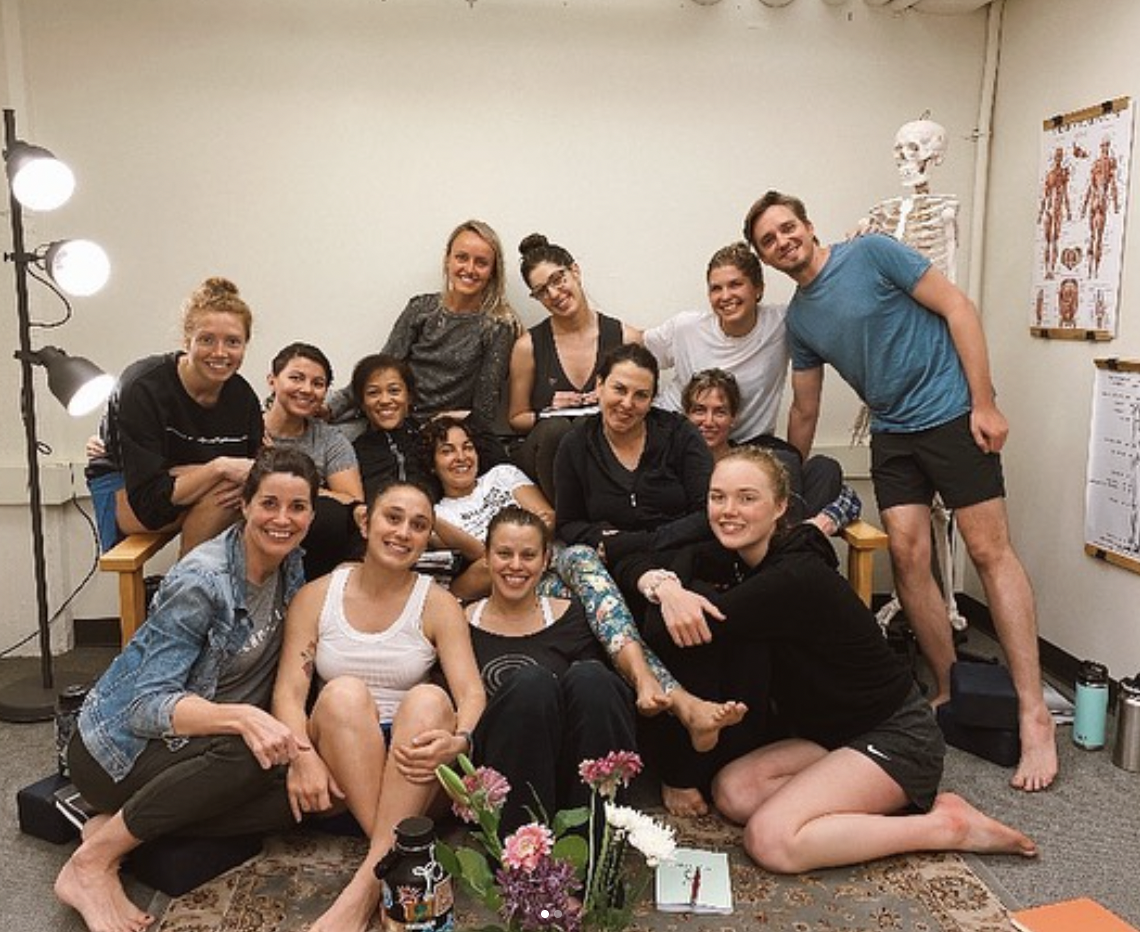
Cute ‘lil snap of me back in my RYT 200-hour yoga teacher training <3
What do people who’ve taken the most recent season of this yoga teacher training have to say about their experience?
A fantastic stamp of approval on the training is to hear a positive review from a friend or acquaintance who has recently attended the training with those same facilitators. Don’t be shy! If there is somebody who takes classes or teaches at a studio who recently graduated- introduce yourself!
Any recent graduate that had a positive experience will be more than thrilled to chat with you about the pros and cons of the training and offer candid thoughts on how it went for them. This will give you good insight into whether that training is a good fit for you.
If you don’t know anybody who recently took the training, ask the facilitator to connect you with a recent graduate who can provide feedback directly to you on their experience.
Do the facilitators have experience teaching to the types of groups I am most interested in serving?
This question is most relevant if you have a specific group you are trying to teach to. For example, let’s say you are a school Teacher and are trying to infuse yoga into your middle school classroom. If your facilitator has taught kids or been a Teacher, that would be a great fit, or at least they should express interest in helping you apply what you are learning in the specific setting you care about.
Similarly, if you plan to teach to a niche group like elderly adults, you’ll want to make sure your training includes a chair yoga section.
There are a host of niche settings where you can make a positive impact in yoga. I recently met a group called Prison Yoga Project that trains volunteers to teach yoga in prisons and jails throughout the United States, as an example.
I’ve also found that continuing education courses have been a great way to build on my own knowledge gained from my initial 200-hour teacher training to apply yoga to specific groups. For example, I went on to complete a 85-Hour prenatal / post-natal yoga teacher training at Folk SF after my initial 200-hour training. Not only has this training been relevant for the New Mom group, I also use what I learned in that training when I’m working with overweight adults to help make the asana practice more accessible to that specific group.
Does the price of this training match what is do-able for me right now?
From the outside, social media influencers can make the life of a fitness professional look very glamorous. While I’m sure there are rare exceptions, the vast majority of yoga teachers are going to need a separate job or source of income in order to live comfortably in a modern city.
I would not recommend that anybody go into debt to pay for a yoga teacher training. Of course, some trainings have helpful payment plans that can make the feasibility of payment more realistic. Similarly, many studios are willing to accept a proposed future payment plan if that makes it approachable for a student.
Many studios offer work-trade programs where you can join the staff as a volunteer for a specific number of hours per month, and in exchange receive discounts on trainings such as a Teacher Training program. This could be a great way to get into training at a discount.
Additionally, if you come from a disadvantaged background, I would encourage you to reach out to a studio to ask if they have scholarship positions or financial aid available for teacher trainings! The worst they can say is no.
If the price of teacher training is making you hesitant to sign-up, I would approach it like this. Ask yourself what extra jobs, gig work, or side-hustles you can pick up before the training to save up enough money where you can offer yourself the gift of the Teacher Training without feeling the weight of debt due to the cost of the training. This will allow you to exist in the training with more presence, peace and ease.
Is this yoga studio somewhere I would want to teach one day?
Ok, this question has a layered answer. I regularly have students who attended trainings at other places approach me asking for teaching jobs at studios where I teach and I think it’s important to consider this before you sign-up for a teacher training.
First off, take a few classes at that studio and be sure the overall vibe and community feels cohesive. If each individual teacher is completely doing their own thing, and there is no common thread between the studio’s teachers, I would say that could be something to avoid.
Sometimes people follow “celebrity” yoga teachers to a training hosted at a studio that is acting more as a ‘venue’. That is totally fine, so long as your ultimate goal is to learn from that individual Facilitator.
Other students are looking for a teacher training where the studio trains teachers who actually are (eventually) hired to teach at that studio. You’ll want to look at the studio’s current teacher roster, and determine how many teachers there actually completed that studio’s teacher training to make sure this is even realistic.
Alternatively, if there is a studio or fitness center where you really want to eventually be hired, reach out to that studio owner before your sign-up for training. Ask that studio owner if they have recommendations for where / who you could complete your training with to have the best possible chance of one day getting hired. They might offer their own training or point you in the direction of a Facilitator that they respect. That will put you on the best possible path to having a place to teach in the future.
Is there a clearly defined ‘path to teach’ following the completion of the yoga teacher training?
If (and this is a really big if) your ultimate goal is to teach yoga at the studio where you complete your training, this is a really important question to ask. Many students are surprised by how many years of experience actually go into teaching before teachers get hired at some of the bigger studios that you might frequent regularly.
Many of the teachers who have been in teacher trainings with me actually didn’t plan on teaching yoga classes following the training. Many applied what they learned in the teacher training to other facets of their life (their professional work, creative arts, relationships, personal yoga practice etc.). If that is you, you can probably skip this question.
At a smaller studio with a newer teacher training program, after talking to the Studio Owner, you might be pleasantly surprised to find that your path to teaching will likely be relatively quick, because they desperately need teachers to cover subs. This is definitely worth a conversation before you sign-up.
At a larger studio, it will really depend. I’ve seen some larger studios that host many, many classes, and are quicker to put in new subs just because the volume necessitates more teachers.
In other large studios, I’ve been through rounds of auditions with years of teaching experience and training required to just get a foot in the door. I totally get it- Studio Owners are pouring soooo many resources into running their business- rent is not cheap these days, and they want to offer the best quality of classes to their community. I actually consider teacher discretion to be a really good thing when looking for a studio to teach at. The path to get on their floor may be longer, however, it might actually be more fulfilling because you’ve put in a lot of energy to be there.
Regardless, I always encourage new teachers to plan to ‘create’ their own opportunities to teach, if teaching is your desired outcome. You will be a better teacher for it!
Is the Yoga Training Program or Facilitator accredited by an organization that matters to me?
There are certain ‘governing bodies’ that matter to particular students or studios when it comes to teaching yoga. For example, a common one in the United States is called Yoga Alliance.
If your ultimate goal is to get hired at a studio teaching yoga, you will want to discern whether that studio focuses on Yoga Alliance credentials, and if it’s necessary, you will want to look for a training that is Yoga Alliance certified. The studio will almost certainly mention this in their program description.
Similarly, different ‘schools’ of yoga have their own teaching tiers and leveling programs that will be very unique based on the school of yoga. I would encourage you to research this before selecting a teacher training. These will vary dramatically depending on the style of yoga you are hoping to teach.
One other thing to keep in mind is that different yoga studios operate differently when it comes to insurance and employment type. Some studios employ me, while others have me on as a contractor. In that case, I need to have my own outside insurance, so just something to keep in mind as you consider expenses related to teaching yoga. Similarly, Yoga Alliance has continuing education requirements so you’ll want to budget accordingly.
In-Person Yoga Teacher Trainings for 2026: My curated list
Ok! In the sheet below I’ve aggregated In-Person Yoga Teacher Trainings for 2026 that I would recommend. Each training is unique, and you should definitely explore more on the facilitators’ websites. You can filter by different items such as: Location, Start Date, Price, Style of Yoga, etc.
My Closing Thoughts on RYT-200 Yoga Teacher Trainings
Is there an upcoming in-person Yoga Teacher Training or Continuing Education Workshop that isn’t on this list and would be a great fit?! Email them to us at hello@waveflowapp.com and we’ll take a look at the program.
I feel passionately that yoga teacher training can be an incredibly effective tool for a person to take an active role in transforming their own life. As crazy as this sounds, I have many yoga teacher friends who have done multiple RYT-200 hour yoga teacher trainings. Yes, they are that good.
I highly recommend you take the plunge and kick off a life-long journey of presence and aligned living. Cheers!